Step 1: Know Your Electricity Consumption
Everything starts with how much electricity you use. You can find this on your electricity bill — look for your annual consumption in kWh, or multiply your average monthly bill by 12.
Typical annual consumption by country:
- United States: 10,500 kWh (average household)
- United Kingdom: 3,500 kWh (medium consumption)
- Australia: 6,500 kWh (average household)
- Canada: 9,500 kWh (average household)
If you only have your monthly electricity bill in dollars/pounds, you can estimate consumption by dividing the bill by your electricity rate. For example: $150 monthly bill ÷ $0.16/kWh = 937 kWh/month = 11,250 kWh/year.
Step 2: Calculate the System Size You Need (kW)
The formula is straightforward:
System size (kW) = Annual consumption (kWh) ÷ (Sun hours per day × 365 × System efficiency)
Using real numbers for a US home:
- Annual consumption: 10,500 kWh
- Average sun hours: 4.5 hours/day
- System efficiency: 0.86 (14% losses)
- System size: 10,500 ÷ (4.5 × 365 × 0.86) = 7.4 kW
This means you would need approximately 7–8 kW of solar panels to cover most of your electricity use. Our solar estimator does this calculation for you using your specific inputs.
Step 3: Convert kW to Panel Count
Once you know your target system size in kW, converting to panels is simple:
Number of panels = System size (watts) ÷ Panel wattage
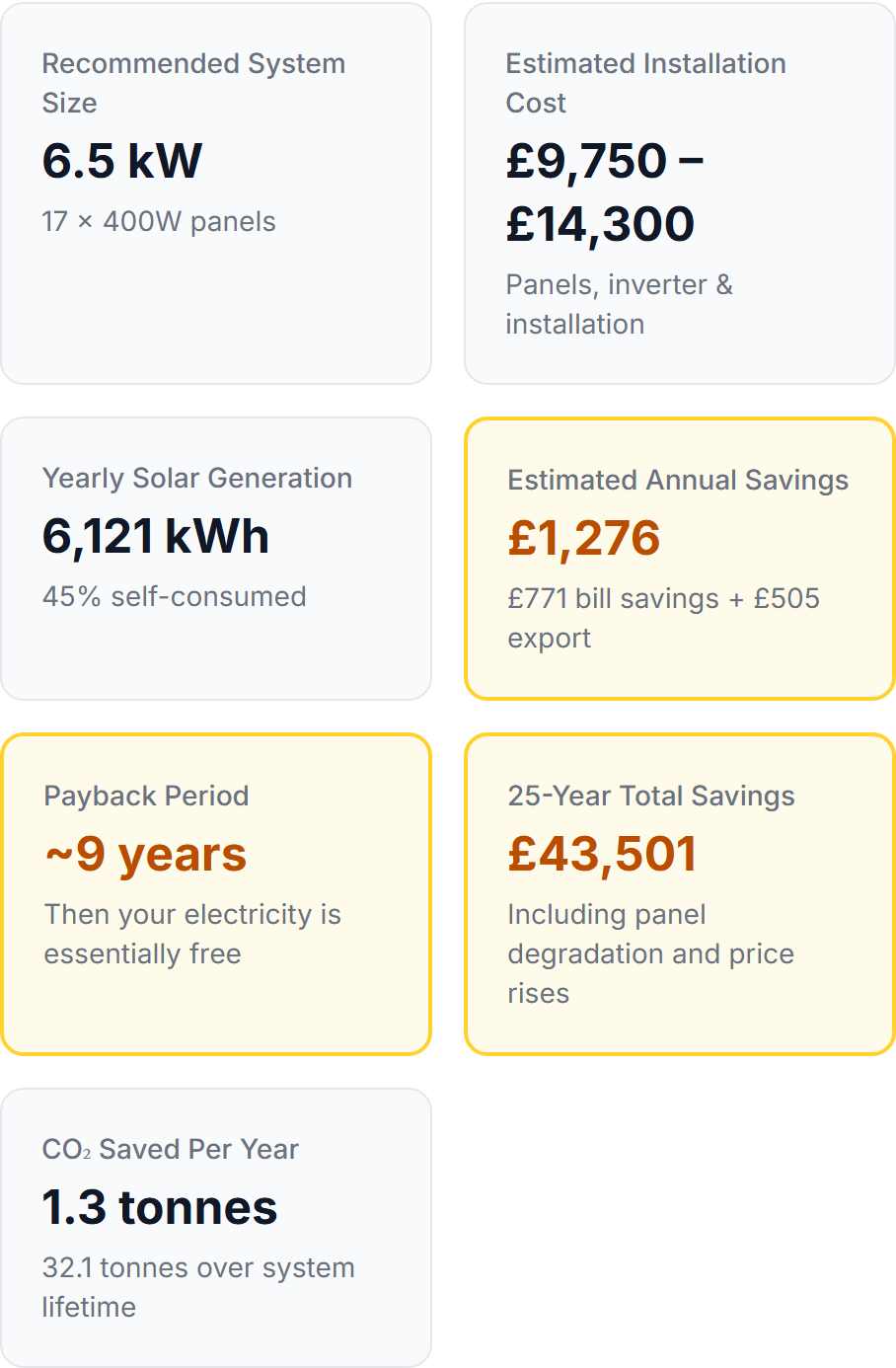
For the 7.4 kW example above using 400W panels: 7,400 ÷ 400 = 18.5 → 19 panels.
Each 400W panel measures approximately 1.04m × 1.72m = 1.79 m². So 19 panels need about 34 m² (366 sq ft) of usable roof space — roughly half a typical US residential roof.
Check whether your roof can physically fit the panels you need using our panel calculator, which accounts for roof space constraints.
Step 4: Check Your Roof Space
Usable roof area is often the limiting factor. "Usable" means south-facing (or north in the southern hemisphere), unshaded, and clear of obstructions. You need to subtract:
- Chimneys, vents, skylights, and satellite dishes
- Edge clearance (typically 30 cm from all roof edges)
- Maintenance access gaps between panel rows
A practical rule: only about 60–70% of your total south-facing roof area is usable for panels once you account for all obstructions and clearances.
If your roof cannot fit enough panels, consider:
- Using higher-wattage panels (420–440W) to get more capacity per square metre
- Adding panels on east or west-facing roof sections (about 85% as productive)
- Ground-mounted panels if you have garden space
Should You Oversize or Undersize?
A system sized to cover 80–100% of your annual consumption is the sweet spot for most homeowners. Here is why:
- Undersizing (50–70%) — you still buy a lot of grid electricity. The system saves money but leaves significant potential on the table.
- Right-sizing (80–100%) — maximises self-consumption value. You export some in summer and import some in winter, which is normal and expected.
- Oversizing (110–130%) — only makes sense if you plan to add an electric vehicle, heat pump, or battery in the near future. Otherwise, you are paying for panels that mostly earn low export rates.
If you are planning to electrify heating or transport within the next few years, sizing up by 20–30% now is a smart move since adding panels later is significantly more expensive per kW than including them in the original installation.
Understanding PV System Specifications
If you are comparing quotes or reading technical specifications, here are the terms you will encounter:
- kWp (kilowatt peak) — the system's rated capacity under standard test conditions. A "6.4 kWp system" has 6,400 watts of panel capacity.
- kWh (kilowatt-hour) — the unit of energy production. This is what appears on your electricity bill and what your panels actually generate.
- Specific yield — annual kWh produced per kWp installed. Ranges from 800 (cloudy locations) to 1,750 (sunny locations).
- Performance ratio — actual output divided by theoretical maximum. Typically 75–85% for well-designed systems.
- DC/AC ratio — the ratio of panel capacity to inverter capacity. Typically 1.1–1.3:1 (slight oversizing of panels relative to inverter is normal and cost-effective).